
Balance disorder- a guide
Giddiness, dizziness, instability, and vertigo all indicate a disorder of the vestibular system, which is responsible for maintaining balance. It is a complex and fragile system of the body, and derangements of the balance system are quite common.
A Detailed discussion on Balance System for Professionals only
A Brief presentation on the Balance System for non-professionals

How common are balance problems?
It might surprise you that balance disorders are quite common. In India, some studies suggest a lifetime prevalence of balance disorders could be as high as 30% overall.
These issues become particularly common with age. This instability in older adults is a serious concern. Balance-related falls account for a significant number of accidental deaths in this age group, both globally and in India.
A study in a West Bengal hospital found that 75% of vertigo patients also reported instability, with 50% experiencing a spinning sensation.
Are Balance Disorders Curable?
Balance disorders are common, but fortunately, diseases of the vestibular system are rarely life-threatening conditions, and most of them are self-limiting. More than 90% of patients suffering from balance disorders are cured only by medication and some exercises.
However, surgery is required, and in a very few, the disorder is of unknown origin (idiopathic) and refractory to treatment. The vertiginous patient must get proper medical treatment
Those patients who have associated features like ear problems e.g., deafness/tinnitus /fullness/ aural discharge, headache, visual disturbances, e.g., blurring of vision/diplopia, and neurological problems like motor / sensory disturbances require referral to a neurotologist.
The other balance disorder patients who require referral are those in whom the giddiness or instability is persistent after 4 weeks or in whom the symptoms are progressively deteriorating with no signs of recovery.
A neurotologist is a medical professional who specializes in the management of balance disorders. The patient usually requires some specialized investigations by which the neurotologist can identify and document the patient’s disability and also establish the cause and localize the site of the disorder in the balance system.
After identifying the pathology, the neurotologist treats the patient according to the nature and site of the disorder. Though most balance disorders are benign, self-limiting conditions, yet the medical practitioner should not take them lightly as sinister conditions like a tumour in the brain or a disabling condition like multiple sclerosis or even a cerebral stroke localised to the posterior part of the brain may present with vertigo/instability only.
The Maintenance of the Body’s Balance
The maintenance of balance is a function of the body’s nervous system. It comprises of parts of the brain, some nerves and muscles and certain special sensory organs. The parts of the brain and the nervous system concerned with the maintenance of balance, and the sensory organs, are collectively known as the vestibular system.
The brain collects information about the body’s position in to the ground, the surroundings, and from 3 sources viz. –
- The vestibular labyrinth, which is a small organ located deep inside our ears,
- The two eyes, and
Some special receptors called proprioceptors are located in the muscles of the legs, soles of the feet, and the buttocks. our backs, etc.
By integrating the information obtained from these 3 sources, the brain recognizes changes in the subject’s position relative to the surroundings and the ground, and also the changes in the position of the head to the body.
Of the 3 sensory inputs to the brain by which the brain recognizes the subject’s position; the vestibular labyrinths (which is the internal sensor of the head) tells the brain how the subject’s head is oriented is space, i.e. the position of the head in relation to the body; the visual system (which is an external sensor) tells the brain whether the surroundings (the world around us) are moving and the proprioceptive system (which also is an external sensor) tells the brain whether the ground on which subject is standing or moving or is unstable.
Common Causes of Balance Problems
A proper coordinated movement of the limb and the trunk prevents the subject from falling down, and a precise movement of the eyes prevents images of the surrounding objects from slipping into the retina. Slippage of the image of surrounding objects in the retina (called retinal slip) occurs whenever there is a relative movement of the head and surroundings.
A perfectly measured and precisely timed movement of the eyes prevents this retinal slip by moving the eyes in such a manner that the image of the surrounding objects remains fixed in the most sensitive part of the retina (called the fovea). Whenever a slip of the image occurs, the patient feels a hallucination of movement, i.e., vertigo.
The corrective movement of the eye is brought about by the vestibulo - ocular reflex system and the corretive movement of the limbs and trunk is brought about by the vestibulo - spinal reflex system. In disorders of the balance system, these mechanisms are jeopardized and the patient not only becomes unstable whenever there is any change in the relative positions of the body and the surroundings, but also experiences hallucination of movement (called vertigo) even when there is no relative change in the position of the body and the surroundings.
- A disorder of the balance system may occur whenever there is any defect in one or more of the different organs, which together comprise the balance system.
- The commonest site of the disorder is the vestibular labyrinth inside our ears. It is a very fragile organ and is susceptible to damage by numerous factors like medicines (e.g., gentamycin, streptomycin, antimalarial drugs, etc.), infections, degenerative changes of aging, trauma to the head, etc.
- However, the defect may very well lie in the other sectors, like the proprioceptors in the legs, the eyes, the muscles of the limb, and the small muscles outside the eyes, and even in the brain itself.
- Metabolic and degenerative changes in the brain due to deficient blood supply in the lower part of the brain (technically called vertebrobasilar insufficiency) are also not uncommon causes of the instability.
- Tumors in the brain, especially in the vestibular nerve, cerebellum, and cerebellopontine angle or in the lower brainstem region, are rare causes of balance disorders.
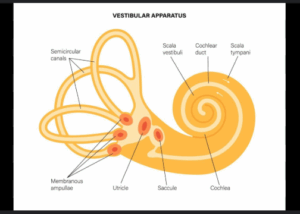
A Closer Look at Your Inner Ear: The Vestibular Labyrinth
The Vestibular labyrinths, which are located deep inside our ears (one on each side), need to be described in a little detail because this is the commonest site of lesion in disorders of balance. The Vestibular labyrinth has 2 parts viz., the semicircular canals and the otolithic organs (utricle and saccule). There are three semicircular canals, which are hollow tubes filled with fluid.
They’re arranged perpendicular to each other, allowing them to respond to all possible directions of body movement. Special motion-sensing cells, topped with tiny hairs that project into the fluid, attach to the walls of these tubes.
During head movement, the fluid lags slightly behind the motion of the rest of the body. This causes the hair cells to bend, which in turn stimulates the balance nerve. The balance nerve (8th Cr.nv.) carries this information to the brain, which recognises the change in position of the head.
The semicircular canals are especially important for coordinating rotating movements. Diseases that affect them often cause a sensation of spinning or turning.
The two otolithic organs also have tiny hair cells. On their surface are minute crystals of calcium carbonate known as otoliths. During head movement, these heavy crystals lag slightly behind the motion of the rest of the body due to inertia, causing the hairs to move and thereby stimulate the balance nerve.
The otoliths are especially important for monitoring linear (straight line) movements and up and down movements. Disorders of this part of the inner ear usually cause a sense of the ground rolling or a feeling like that of dropping in an elevator.
When to Seek Help: Understanding the Diagnostic Process
Vestibular labyrinth diseases are called peripheral disorders. It includes diseases like Meniere’s disease, infective labyrinthitis, perilymph fistula, benign paroxysmal positional vertigo, etc.
Disorders may also involve the balance nerve, which carries the sensation from the vestibular labyrinth to the brain. These include diseases like vestibular neuronitis and acoustic neuroma.
A subject gets the sensation of vertigo or imbalance when one of the following things happens-
- Any one or more of the sensory receptors for maintenance of balance viz.- the vestibular labyrinth (s), the eyes, or the proprioceptors in the muscles, is defective,
- There is a mismatch between the information about spatial orientation received from the vestibule with the information received from the other sensory systems viz.- the proprioceptive and visual systems.
- The central nervous system (CNS) fails to integrate the information received from the vestibular, proprioceptive, and visual systems,
- The CNS fails to effectively generate the motor output and
- The motor output system for the maintenance of balance is defective.
The treatment as well as the prognosis (i.e. the outcome of treatment) varies according to the nature and site of the disorder. The neurotologist diagnoses the disorder by the help of some specialized clinical tests (called neurotological tests) and investigations (called vestibular function tests).
Conclusion
Your balance system is crucial, and while issues like dizziness can be unsettling, most balance disorders are treatable. Don’t dismiss persistent giddiness or unsteadiness.
A proper diagnosis is key to understanding and recovering from your discomfort. With timely care, you can often regain stability and get back to enjoying life.
Frequently asked questions
1. What’s a balance disorder?
It’s a condition making you feel unsteady or dizzy, like spinning or falling. It happens when your body’s balance system isn’t working right.
2. What are the common symptoms?
Common symptoms include giddiness, dizziness, instability, and vertigo (a spinning sensation). You might also feel lightheaded or disoriented.
3. Can balance disorders be cured?
Yes, over 90% of cases can be cured or greatly improved with proper diagnosis, medication, and exercises. Surgery is rarely needed.