

The BERA test full form is Brainstem Auditory Evoked Response. The Brainstem Evoked Response Audiometry (BERA) test is a crucial diagnostic tool that tests how our brain responds to sound.
If you are someone worried with your own hearing or concerned about your child’s speech development, this comprehensive guide will provide all the essential details you need to know.
What is the BERA test ?
The Brainstem Auditory Evoked Response test examines how electrical waves are sent from our nerves to our brainstem in response to the noises that are delivered through our ears.
The BERA test is also known as Auditory Brainstem Response (ABR) or Brainstem Auditory Evoked Potentials (BAEP). All these terms refer to the same diagnostic procedure.
Unlike traditional hearing tests that rely on a patient’s active participation, BERA assesses the auditory pathway’s function from the ear to the brainstem without requiring any subjective response.
Why is the BERA test important?
Hearing loss in children, if undetected and unaddressed, can lead to devastating consequences, including delayed speech and language development, poor academic performance and social isolation.
According to the National Medical Journal of India, 2022, around 16.4% children are at risk of hearing loss.
Here, the BERA hearing test can make a difference. The Brainstem Auditory Evoked Response (BERA) is known for its objective diagnosis, where one can get reliable results without the patient’s participation. Otherwise, it is difficult to conduct tests that would require participation, on children with hearing loss issues.
Why is the BERA test required?
Early and accurate diagnosis has always proven to be important. A doctor can suggest the Brainstem Evoked Response Audiometry test for the following reasons-
- Doctors use it to monitor both central and peripheral nervous systems during surgeries, such as those for Meniere’s disease or facial palsy.
- The test supports screening and planning for cochlear implant procedures.
- It is useful for detecting hearing loss due to retro-cochlear issues like acoustic schwannoma or neuroma.
- It aids in diagnosing demyelinating conditions like multiple sclerosis.
- The BERA hearing test helps in selecting and fitting hearing aids for infants and children.
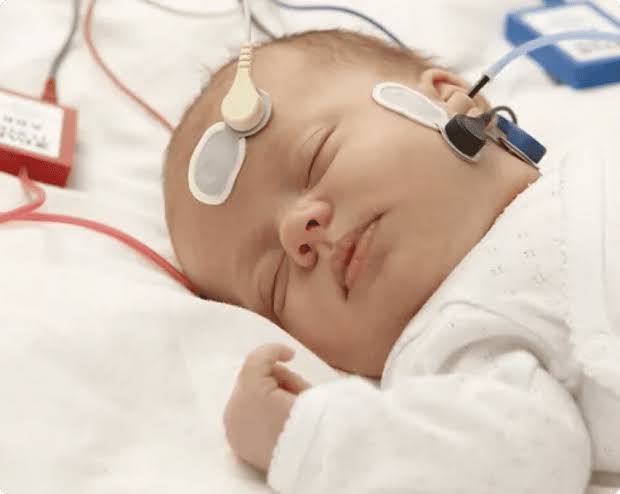
BERA TEST ON BABY
Indications for BERA Test for Babies and Children
BERA test for babies is crucial in cases such as:
- Newborn Hearing Screening Failures
- Delayed Speech and Language Development
- Suspected Hearing Loss
- Babies born prematurely
- Babies with history of infections
Indications for BERA Test in Adults
Although it is not common to use BERA hearing test in adult, However, here is a list of cases where BERA ear test can be crucial for adults:
- Unexplained Hearing Loss
- Tinnitus
- Neurological Conditions
- Difficulty with Speech Understanding
BERA test price
The Brainstem Evoked Response Audiometry Test starts from 1400 and goes up to 4000 in India. The test is available in many diagnostic centres in Kolkata. Some of which offer discounts as well.
It’s always advisable to call different centers in your area to get precise quotes and understand what is included in the fee.
You can visit here for an appointment
How is the BERA test done?
Understanding the procedure can help ease any anxieties you might have. The BERA ear test is non-invasive and generally well-tolerated. Here is your step-by-step guide
- Electrode Placement: A trained audiologist or technician will clean a few small areas on your scalp, typically on the forehead and behind each ear, and attach small, sticky electrodes. These electrodes are harmless and simply detect electrical signal
- Headphone/Earphone Placement: You will be fitted with headphones or insert earphones through which a series of clicks or tones will be presented.
- Sound Delivery: These sounds are delivered at varying intensities and rates.
- Signal Detection: The electrodes pick up the tiny electrical responses from your auditory nerve and brainstem. These signals are then sent to a computer that averages them and displays them as waveforms.
- Duration: The test typically takes anywhere from 30 minutes to 2 hours, depending on the patient’s cooperation and the clarity of the responses. For babies, it’s often longer as they need to be asleep.
Things to keep in mind before the test
Proper preparation before the test is important to get accurate results. Here is a list of things to keep in mind before the test:
BERA test For babies
- Cleanliness: Ensure the scalp is clean and free of oils, gels, or sprays.
- Sleep Deprivation: For infants and young children, it’s often recommended to keep them awake for a few hours before the test so they are sleepy and can fall asleep naturally during the procedure.
- Feeding: Bring bottles or feeding supplies to feed the baby just before or during the test, as a full, sleepy baby is more likely to cooperate and remain still.

ABR TEST FOR ADULTS
BERA test For adults
- Avoid Caffeine: While not strictly forbidden, excessive caffeine might affect brain wave activity.
- Relaxation: Try to be as relaxed as possible. Movement can interfere with the results.
How to interpret the BERA test report?
Your report will typically display a series of waveforms. The result lies in the BERA wave interpretation. The BERA waves are generally labelled as Waves I, II, III, IV, V. VI and VII. 7 BERA waves are recorded in the first 10 milliseconds.
Each peak in the waveform corresponds to electrical activity at different points along the auditory pathway from the inner ear to the brainstem.
Here is how BERA waves interpretation is done-
- Presence/Absence of Waves: The presence or absence of specific waves indicates whether sound signals are reaching the corresponding parts of the brainstem.
- Latency: The time it takes for each wave to appear after the sound stimulus. Prolonged latency can indicate a problem in the auditory pathway.
- Interpeak Latency: The time difference between specific waves. This helps pinpoint where along the pathway a delay or issue might exist.
- Wave Morphology: The shape and amplitude of the waves can also provide diagnostic information.

BERA WAVE INTERPRETATION
What are the limitations of the BERA test?
Although the BERA ear test is highly effective, it can still have certain limitations. Here is a detailed list:
- Does not assess higher-level processing: BERA assesses the integrity of the auditory pathway up to the brainstem. It cannot evaluate how the brain will interpret or understand the sound. These are higher cortical functions.
- Affected by patient state: Although objective, excessive movement, muscle tension, or electrical noise in the environment can affect the clarity of the waveforms and necessitate longer testing times or sedation.
- Requires specialized equipment and trained personnel: The test needs sophisticated audiometric equipment and an experienced audiologist or neurophysiologist for accurate administration and interpretation.
- Does not pinpoint the exact cause of hearing loss: The BERA test report can identify where the problem is but it can’t necessarily provide details on what neurotologocial condition it is.
Side effects of BERA test
The best thing about the BERA test or Brainstem Evoked Response Audiometry Test is that it does not have any side effects. It is non-invasive and safe.
Since it only involves placing electrodes on the skin and playing sounds through headphones, there are no risks associated with the procedure itself. You may experience minor skin irritation from the electrode adhesive, which usually subsides quickly.
When to call us?
If you have concerns about your hearing or your child’s speech and language development seems to be delayed then don’t hesitate to reach out. Early diagnosis and intervention are key to managing hearing-related issues effectively.
You should contact us if
- You suspect hearing loss in yourself or a family member.
- Your child is exhibiting delayed speech or language development.
- A newborn hearing screening has failed.
- You have persistent tinnitus or unexplained hearing changes.
- Your doctor has recommended a BERA test and you need to schedule an appointment or have further questions about the procedure
Conclusion
The BERA test or the Brainstem Evoked Response Audiometry Test has been one of the most invaluable tools in the world of objective diagnostic tools in audiology. It is particularly a boon to those adults and children who cannot participate in traditional subjective hearing tests.
By precisely measuring the brain’s electrical responses to sound, the BERA test offers crucial insights into the health and function of the auditory pathway from the ear to the brainstem. This blog helps you understand the purpose and procedure of the BERA test. So that you can avail help at the right moment in the right place.
Frequently Asked Questions
- What is the BERA test?
- The Brainstem Auditory Evoked Response is a non-invasive hearing test that measures how your brain responds to sounds. It is alternatively known as ABR.
- Is the ABR test painful?
- No, the ABR test is completely non-invasive and painless. You will only feel the placement of electrodes and hear sounds through headphones.
- How long does an ABR test take?
- The BERA test or the ABR test typically takes between 30 minutes to 2 hours. It depends on factors like cooperation and the clarity of responses. For infants, it’s usually longer as they need to be asleep.
- How do doctors interpret the test report?
- The BERA test report shows BERA waves (I-VII). Their timing (latency) and shape help us understand how sound signals travel from your ear to your brain stem.