

BERA test on baby
Introduction
The BERA test stands for Brainstem Auditory Evoked Response. It is an important diagnostic tool that is used to assess hearing functions. The BERA test is particularly used for infants and young children.
The BERA test is also known as Auditory Brainstem Response (ABR) test. This test primarily checks how sound signals travel from the ear to the brain. The BERA or ABR test is completely non-invasive.
This blog will help you understand why this simple test can protect your child’s development.
What is the BERA test?
The Brainstem Auditory Evoked Response test measures the brain’s electrical activity in response to sound. It is done by placing small electrode’s on the head. The electrodes are responsible for picking up signals.
The process of the ABR test is completely non-invasive. Hence, there is no pain and discomfort. This is why this test is one of the most recommended tests for children.
As the process of the test is completely objective, it does not require complete participation of the patient.
Why is the BERA Test So Important for Your Child?
From the moment a baby is born, hearing plays a vital role. Hearing is extremely crucial for a child’s development. It helps them recognise voices and eventually speak.
If a baby has hearing loss, they might struggle with:
- Speech delays
- Learning difficulties
- Social and emotional challenges
Usually, most of the parents do not realise that their child is facing hearing issues until the child is 2-3 years old. As, by this time, children atleast start blaberring words. By then, crucial time for early intervention is lost.
Early detection is key to any kind of health issues.
This is where the BERA test becomes important for babies. The test can detect hearing problems as early as a few weeks after birth.
The BERA test gives the child the best possible chance to develop speech, language, and social skills on par with their hearing peers. It is not just a diagnostic tool. It is a gateway to ensuring your child’s comprehensive development and future success.

Causes and Consequences of Hearing Loss
Risk Factors for Babies
The Brainstem Auditory Evoked Response test is not compulsory for every baby. A doctor recommends the Brainstem Auditory Evoked Response test or the ABR test if the baby falls under certain risk factors. These risk factors include
- Low birth weight (less than 1.5 kg)
- Birth complications or lack of oxygen at birth
- Severe jaundice requiring phototherapy
- Family history of childhood hearing loss
- Infections during pregnancy (like rubella, cytomegalovirus)
- Babies in NICU for more than 5 days
- Use of certain antibiotics that can affect hearing
If your baby falls into any of these categories, a BERA test is a simple way to ensure their hearing is developing normally.
Common myths about the BERA test debunked
Misconceptiond regarding the BERA or the ABR test are common. Here are some of the myths debunked by us.
Myth- The BERA test is painful for babies
Fact– The BERA test is completely painless as the test is non-invasive. The baby typically sleeps through the whole process. Small electrodes are placed on the baby’s head. These are similar to sticky bandages.
Myth- My baby is too young for a hearing test.
Fact– It is crucial to understand that the BERA test is specifically made for infants and newborns. The ABR test does not require any active participation from the child’s side. This makes the test ideal for newborns. Early detection is the key to every health condition.
Myth – The BERA test uses radiation.
Fact- The BERA test uses sound waves and measures electrical brain activity. There is absolutely no radiation involved, making it a very safe procedure.
Myth – If my baby responds to loud noises, their hearing is fine.
Fact- While a startle response to loud noises can indicate some level of hearing, it doesn’t rule out partial hearing loss or hearing loss in specific frequencies. The test provides a more comprehensive and objective assessment of the entire auditory pathway.
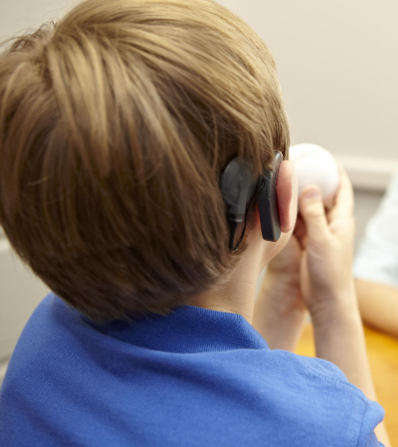
Child with hearing implants
The Long-Term Impact: How BERA Helps Your Child Thrive
The impact of the test lies in early intervention. If hearing loss is detected early then it allows your child to receive timely support and required treatment.
An early intervention can help your child with :
- Normal language and speech development
- Better learning in school
- Improved social and emotional skills
The ABR test is not just about detecting the problem. It is about safeguarding the child and offering the child a world of possibilities. It also empowers the parents as well as the medical professionals to decisive action. This eventually leads to a future where children with hearing loss can not only participate but truly thrive in all aspects of life.
Conclusion
The Brainstem Auditory Evoked Response test is an invaluable diagnostic tool specifically helpful for children. This non-invasive and simple test can provide crucial insights about the child’s hearing ability. Early detection of hearing loss through this test can dramatically impact a child’s speech, language, cognitive, and social-emotional development.
By understanding the importance of the BERA test, recognizing risk factors, and dispelling common myths, parents can make informed decisions to ensure their child receives the best possible start in life.
FAQs
1. At what age can the BERA test be done for babies?
The test can be done even in newborns, ideally within the first 3 months if needed.
2. Does my baby need to be awake during the BERA test?
No, in fact, it’s best if your baby is asleep. Natural sleep is preferred for accurate results.
3. How is the BERA test different from normal hearing tests?
Normal hearing tests depend on responses (like turning head to sound), while the BERA measures brain signals directly, so it’s perfect for babies who cannot respond yet.
4. What happens if my baby’s ABR test is abnormal?
Don’t panic. Your doctor will recommend further tests and discuss the best steps to help your child.